Home » Design » VENINI - Salone del Mobile '26

VENINI - Salone del Mobile '26

 - Gabriella Ruggieri & partners

Venini is Venini.

I've said this before, but it's a thought that still holds true for me.

Venini is a brand (as they say these days) that you go see no matter what. It doesn't matter if it's showcasing new pieces or pieces from the past, you just go.

Venini embodies the essence of masterful glassblowing. It embodies history, culture, timeless beauty, and a space open to the elegance of fantasy.

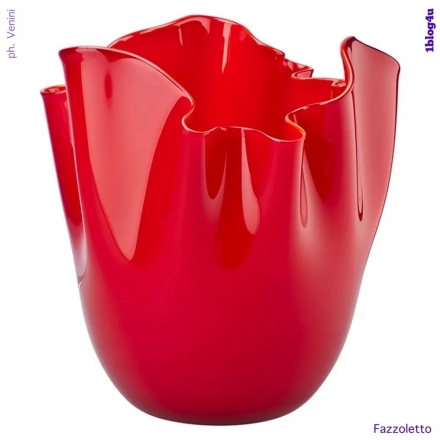
The first time I saw a Venini piece, I was very young. I didn't have the faintest idea who Venini was, but I remember as if it were today, being enchanted by its beauty. Time seemed to have stood still, as if it were just me and that work of art. “Fazzoletto”. Pure magic.

Yes, I'd call it a moment of pure magic. Then I researched, read, and delved deeper, and the rest is history.

I want to tell you a funny story. Just to make you smile.

Years ago I went to a company for a business appointment, I had to meet the owner.

They showed me to a meeting room, asked me if I wanted a coffee and to wait a few minutes.

I put my bag down and look around. Nothing out of the ordinary. A large glass table, chairs all around, bottles of water neatly arranged on a tray with glasses.

Around it, a bookcase, some paintings hanging on the walls, and then some low cabinets with magazines, catalogues, some vague steel sculptures on them, and then him… in the back, in a slightly dusty corner, a red “Fazzoletto”.

Wow,” I say to myself.

I get closer and inside there were some paper clips, some old candy, and various knick-knacks.

I was still clearly shocked when my interlocutor entered. And I asked, "Whose is this?" and he was clearly surprised by this approach, almost stammering, "It's mine, it's a souvenir from my mother."

May I?” I said, intending to touch it to check the signature. “Please,” moving closer, curious.

And after checking it out and saying, “Do you know it’s a work of art?” and witnessing his silent but interested amazement, I launch into a passionate 'rant' about Fazzoletto and Venini.

I'll cut the story short.

After this brief interlude, the meeting proceeded as usual and was fruitful, concluding with the signing of a contract.

Some time passes, I return to the company, this time I had to meet the MKTG Director and while they were directing me towards the meeting room, I saw a lit display case with the Red “Fazzoletto” inside...!!

Along the corridor, a little far away, I glimpse the owner, I raise my hand to greet him and then with my index finger I point to the display case.

He raises his hand to return the greeting and winks at me before continuing in another direction.

An example of pure complicity. He knew, I knew, and the Red “Fazzoletto”  had gotten justice.

Back to us, below you'll find a brief description of the pieces we photographed. I hope you enjoy them, and we invite you to visit their website. Last but not least, we thank them for their hospitality, kindness, and the material they provided.

Enjoy the reading.

Gabriella Ruggieri for 1blog4u 
 - Gabriella Ruggieri & partners

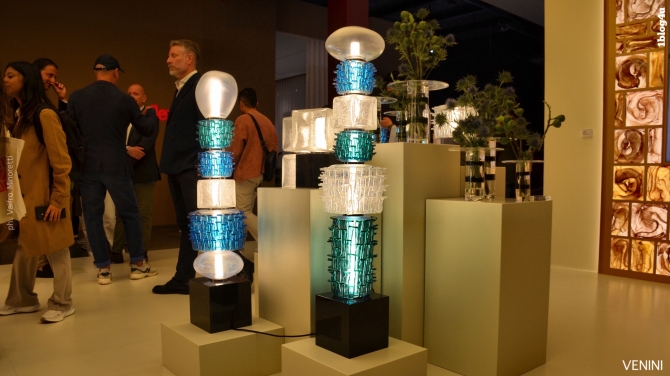
Cactus by Fulvio Bianconi

The Cactus floor lamps embody a perfect dialogue between solidity and lightness, celebrating nature. The base, made of black Zimbabwe marble, provides a solid and refined presence, while the glass structure evokes lightness and transparency. The crystal glass elements are crafted using the pulegoso technique, which traps air bubbles within the glass, creating a unique visual effect. These are alternated with smooth blown glass elements and decorations in the Ritagli style, a technique conceived by Fulvio Bianconi in the 1980s. These lamps, a perfect synthesis of contemporary design and Murano’s artisanal tradition, transform contrasting materials into a visual harmony that pays homage to nature. Available in a limited edition in three sizes.

Fulvio Bianconi settled in Milan and collaborated throughout his life with the Milanese publishing houses Mondadori, Bompiani and Garzanti as a graphic designer and illustrator. He also dedicated himself to painting frescos in the Galtrucco stores and in the Pavilions of the Milan Trade Fair. These occupations were combined with his constant passion for glass. 
In 1946, he repeatedly went to Murano to study the art of glassmaking. Here he met Paolo Venini, a decisive meeting for both of them: this young man’s creativity marked a breaking point in the history of VENINI. Vehement research and experimentation with new glassmaking techniques, which often implies re-elaborating very ancient skills, is a constant in Fulvio Bianconi’s work. New movements and colours emerge in the glass and retrace the bond between the history of Murano and a great modernity. 
This contamination between craft and creative flair has given rise to several iconic works, such as the Figure della Commedia dell’Arte, the Tiepolo, the Fazzoletto, the Sirene and the Pezzati.   Paolo Venini In 1921, Paolo Venini, who was a Milanese lawyer with a long family tradition in glassmaking, founded the company that would take the name VENINI with Giacomo Cappellin, an antique dealer. The company was established with the goal of transforming the classic craft of the glassmaker into an innovative art that could quickly dominate the scene at the Triennale exhibitions in Milan, the Biennale in Venice, and of exhibitions all over Europe and the United States. 
A result that was made possible by the synergy, which was promoted by Venini himself, between master glassmakers, designers, and architects from all corners of the world that could anticipate and guide taste and imbue each model that came out of its kilns with a precise identity.  
Its confident aesthetical choices, together with the extremely high quality of the products, brought its glassworks increasing success among critics and audiences. 
Paolo Venini himself had been designing since the early 1930s: the Diamante glasses are from 1936, and, in collaboration with Carlo Scarpa, he created the Murrine romane.


 - Gabriella Ruggieri & partners

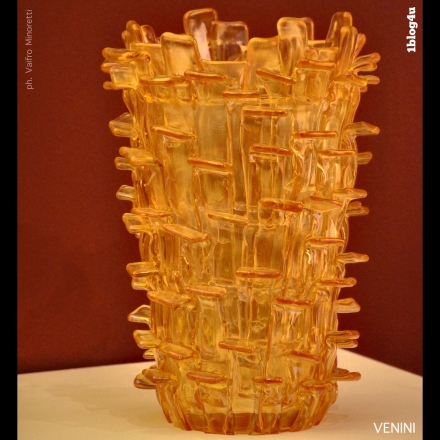
Ritagli by Fulvio Bianconi

Designed by Fulvio Bianconi in 1989, Ritagli was created using a distinctive glassmaking technique conceived by the designer himself: small rectangular strips of glass are layered one over another onto a hand-blown, truncated-cone base. Different colours meet across the surface, creating a composition that evokes both the forms of vegetation found in desert landscapes and the geometries of futuristic architecture.

Handcrafted in Murano by VENINI master glassblowers, each Ritagli is the result of an exceptional artisanal process requiring precision and expertise. Its annual numbering highlights the uniqueness of each piece, making every vase an expression of Fulvio Bianconi’s creativity and VENINI’s glassmaking mastery.

 - Gabriella Ruggieri & partners

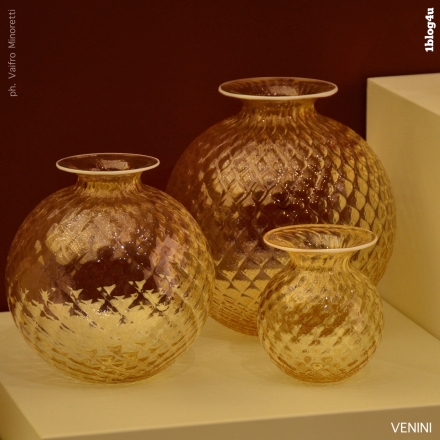
Monofiore Balloton

Monofiore Balloton is a blown glass vase produced in Murano bearing the distinctive mark of the balloton technique, a unique glassworking process that recreates the quilted fabric effect in glass. The crossed relief surface transforms each piece into an extraordinary optical illusion: what appears soft is glass.
Entirely handcrafted by Murano master glassblowers, each Monofiore Balloton is blown and then finished with a coloured thread applied hot, tracing and enclosing the floral decoration with artisanal precision. The variations that distinguish every piece are tangible proof of exceptional craftsmanship, making each Monofiore an authentic and unrepeatable expression of VENINI's glassmaking tradition.

 - Gabriella Ruggieri & partners

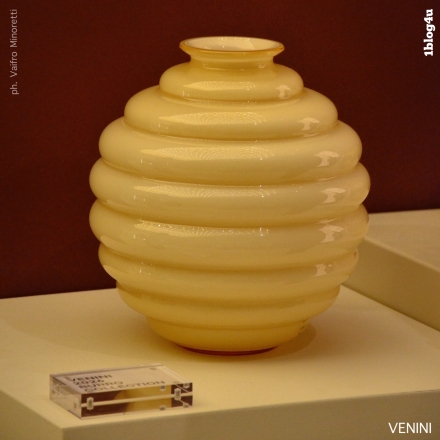
Deco by Napoleone Martinuzzi

Rhythm: this is the word that defines the shape of the Deco series of vases.
The rings are repeated, one after another.
They increase, decrease, then increase again.
They seem to move like circles in the water with ripples and reflections.
This movement is a dance.

A sculptor, designer, and entrepreneur in the glassmaking industry, Napoleone Martinuzzi was trained at the Accademia di Belle Arti in Venice. 
Gabriele D’Annunzio’s favourite, he started creating several works for the latter in 1917. 
From 1922 to 1931, he directed the Glassmaking Museum in Murano. Then, he began working for the company Succ. Andrea Rioda and founded “Vetri Soffiati Muranesi Venini & C.” with Paolo Venini and Francesco Zecchin, where he became the artistic director. 
After an initial period in which he continued working with the artistic concepts of his predecessor Vittorio Zecchin, creating beautiful pieces in hand-blown glass, he started elaborating his own style which derives from his experience as a sculptor. 
In 1932, he left VENINI and founded “Zecchin-Martinuzzi Vetri Artistici e Mosaici” with Francesco Zecchin. Here, he created pieces in refined, matt and pulegoso glass with a remarkable plastic effect. 


Visit the Gallery (ph. Vaifro Minoretti) ph. Fazzoletto by Venini